BLOGGER TEMPLATES AND TWITTER BACKGROUNDS »

Olympics Photo of the Day

Tuesday, June 2, 2009

1920 Summer Olympics

The 1920 Summer Olympics, officially known as the Games of the VII Olympiad, were held in 1920 in Antwerp, Belgium. The 1920 Games were awarded to Antwerp to honour the suffering of the Belgian people during World War I. [1]
The 1916 Summer Olympics, to be held in the German Empire capital Berlin had been cancelled. The results of World War I and the Versailles Peace Conference affected the Olympic Games because new states were created. The Games were also affected by sanctions against the nations that lost the war and received the blame for starting it.
Budapest was going to host the 1920 games. However, the Austro-Hungarian Empire had been an ally of Germany in the First World War. Because of this, the (now independent) Hungary lost the right to hold the games, and was not even allowed to take part. Germany, Austria, Bulgaria and Turkey were also banned from the 1920 Summer Olympics.

Participating nations

A total of 29 nations participated in the Antwerp Games, only one more than in 1912, as Germany, Austria, Hungary, Bulgaria and Turkey were not invited. From the newly-created European states, only Estonia and Czechoslovakia took part. The Yugoslavia, Brazil, Finland and Monaco competed as nations at the Olympic Games for the first time. New Zealand, which had competed as part of a combined team with Australia in 1908 and 1912, competed on its own for the first time.
 Argentina
 Australia
 Belgium
 Brazil
 Canada
 Chile
 Czechoslovakia
{ Denmark
 Egypt
 Estonia
 Finland
 France
 Great Britain
 Greece
 India
 Italy
 Empire of Japan
 Luxembourg
 Monaco
 Netherlands
 New Zealand
 Norway
 Portugal
 Union of South Africa
 Spain
 Sweden
 Switzerland
 United States
 Kingdom of Yugoslavia

1916 Summer Olympics

The anticipated 1916 Summer Olympics, which were to be officially known as the Games of the VI Olympiad, were to have been held in Berlin, Germany. When World War I started in 1914, organization of the Games continued because no one thought the war would continue for four years. The games were eventually cancelled. Germany won the bid for the Games over Alexandria and Budapest.
A winter sports week with speed skating, figure skating, ice hockey and nordic skiing was planned. The main stadium would have been the Deutsche Stadion (German Stadium), which was built in 1912 – 13. Berlin returned to Olympic bidding in 1931 when it beat Barcelona, Spain for the right to host the 1936 Summer Olympics.

1912 Summer Olympics

The 1912 Summer Olympics, officially known as the Games of the V Olympiad, were held in 1912 in Stockholm, Sweden. For the first time, athletes in the Games came from all five continents symbolized in the Olympic rings. It was also the last time that solid gold medals were given to winners; modern medals are usually silver covered in gold. The main arena was Stockholms Olympiastadion.

Participating nations

28 nations competed in Stockholm.
 Australasia
 Austria
 Belgium
 Bohemia
 Canada
 Chile
 Denmark
 Egypt
 Finland
 France
 Germany
 Great Britain
 Greece
 Hungary
 Iceland
 Italy
 Empire of Japan
 Luxembourg
 Netherlands
 Norway
 Portugal
 Russian Empire
 Serbia
 Union of South Africa
 Sweden
 Switzerland
 Turkey
 United States

1908 Summer Olympics

The 1908 Summer Olympics, officially known as the Games of the IV Olympiad, were held in 1908 in London, England. These games were originally scheduled to be held in Rome. At the time, they were the fifth modern Olympic games. However, it was later decided that the 1906 Summer Olympics would not be considered an official Olmpiad.
Italian authorities were preparing for the Games when Mount Vesuvius erupted on April 7, 1906, devastating the nearby city of Naples. Money that would have gone to the Olympics in Rome were used to help re-construct Naples. London was then selected to host the Games, and they were held in White City alongside the Franco-British Exhibition, which at the time was the more noteworthy event. Berlin and Milan were the other candidates.

Participating nations

The 1908 Games had athletes representing 22 National Olympic Committees. Argentina, Finland, Turkey, and New Zealand (as part of the team from Australasia) made their first appearance at the Olympic Games.
 Argentina
 Australasia
 Austria
 Belgium
 Bohemia
 Canada
 Denmark
 Finland
 France
 German Empire
 Great Britain
 Greece
 Hungary
 Italy
 Netherlands
 Norway
 Russian Empire
 Union of South Africa
 Sweden
 Switzerland
 Ottoman Empire
 United States

1906 Summer Olympics

The 1906 Summer Olympics, also called the 1906 Intercalated Games, were held in Athens, Greece. These games are not awarded the title of Olympiad because they were held between the III and IV Olympiads. Medals were given to the participants during these games, but the medals are not officially recognized by the International Olympic Committee.

1904 Summer Olympics

The 1904 Summer Olympics, officially known as the Games of the III Olympiad, were held in St. Louis, Missouri in the United States from July 1, 1904 to November 23, 1904, at what is now known as Francis Field on the campus of Washington University in St. Louis. Chicago had won the original bid to host the games, but the Louisiana Purchase Exposition would not accept another international event in the same time frame. The organization began to plan for its own sports activities, informing the Chicago Organizing Committee for the Olympic Games that the Exposition would try to make the Olympic Games less important than the Exposition games unless the Olympic Games were moved to St. Louis. Pierre de Coubertin, the founder of the modern Olympic movement, finally agreed...
St. Louis repeated the mistakes made at the 1900 Summer Olympics in Paris. Competitions were reduced to a side-show of the World's Fair and were lost in the chaos of other, more popular cultural exhibits. David Francis, the President of the Louisiana Purchase Exposition, did not invite anybody else to open the games and, on July 1, 1904, did so himself in a small, short 'ceremony'.
Officially, the games lasted for months; in fact, James Edward Sullivan tried to hold an event every day of the fair. The Olympic events were again mixed with other sporting events, but unlike Paris, who hardly ever mentioned the Olympics, Sullivan called all his sports events "Olympic". From these events, the International Olympic Committee declared 94 of them to be Olympic. A total of 651 athletes competed in the games—645 men and 6 women, representing 12 countries. In fact, only 42 of the events actually included athletes who were not from the United States. The majority of the recognized Olympic sports were held from Monday, August 29 to Saturday, September 3, 1904.

1900 Summer Olympics

The 1900 Summer Olympics, officially known as the Games of the II Olympiad, were held in 1900 in Paris, France. No opening or closing ceremonies were held but competitions began on May 14 and ended on October 28. The Games were held as part of the 1900 World's Fair. Over a thousand athletes competed in 19 different sports. Women took part in the games for the first time and Charlotte Cooper became the first female Olympic champion. Many American athletes opposed competing on a Sunday because they travelled as representatives of their colleges and were expected to withdraw rather than compete on the "sabbath".
Most of the winners in 1900 were given cups or trophies instead of medals. Professionals competed in fencing and Albert Robert Ayat, who won the épée for amateurs and masters, was awarded a prize of 3000 francs.

1896 Summer Olympics


The 1896 Summer Olympics, officially known as the Games of the I Olympiad, were celebrated in Athens, Greece from April 6, through April 15.

Summer Olympic Games


The Summer Olympic Games or the Games of the Olympiad are an international sporting event which are held every four years by the International Olympic Committee. The "Games", as they are often called, are held in a different city each time. It is a great honour for a city to be "awarded" (given) the right to hold the Olymic Games. Two years after the Summer Olympics, the Winter Olympic Games are held. These are always in a cold, mountainous place because the sports are all snow and ice sports such as skiing. Many more countries send athletes to the Summer Olympics than to the Winter Olympics.
The Olympic Games were first held in Ancient Greece more than two thousand years ago. The first modern Summer Olympic Games where held in Athens in 1896. There were 200 athletes from Greece and 45 athletes from 13 other countries. From 1904, medals are given to the three best athletes or teams in each sport.
The earliest Games consisted of 42 events only, but it is expected that 10,500 athletes compete in the 302 events on the program for the 2008 Summer Olympics in Beijing.

List of modern Summer Olympic Games


Games in italics were cancelled or have not yet been held.
1896 - Games of the I Olympiad - Athens, Greece
1900 - Games of the II Olympiad - Paris, France
1904 - Games of the III Olympiad - St. Louis, Missouri, United States
1906 - Intercalated Games - Athens, Greece
1908 - Games of the IV Olympiad - London, United Kingdom
1912 - Games of the V Olympiad - Stockholm, Sweden
1916 - Games of the VI Olympiad - Berlin, Germany - Cancelled due to World War I
1920 - Games of the VII Olympiad - Antwerp, Belgium
1924 - Games of the VIII Olympiad - Paris, France
1928 - Games of the IX Olympiad - Amsterdam, Netherlands
1932 - Games of the X Olympiad - Los Angeles, California, United States
1936 - Games of the XI Olympiad - Berlin, Germany
1940 - Games of the XII Olympiad - Helsinki, Finland - Cancelled due to World War II
1944 - Games of the XIII Olympiad - London, United Kingdom- Cancelled due to World War II
1948 - Games of the XIV Olympiad - London, United Kingdom
1952 - Games of the XV Olympiad - Helsinki, Finland
1956 - Games of the XVI Olympiad - Melbourne, Australia / Stockholm, Sweden (Equestrian events)
1960 - Games of the XVII Olympiad - Rome, Italy
1964 - Games of the XVIII Olympiad - Tokyo, Japan
1968 - Games of the XIX Olympiad - Mexico City, Mexico
1972 - Games of the XX Olympiad - Munich, West Germany (now Munich, Germany)
1976 - Games of the XXI Olympiad - Montréal, Quebec, Canada
1980 - Games of the XXII Olympiad - Moscow, Soviet Union (now Moscow, Russia)
1984 - Games of the XXIII Olympiad - Los Angeles, California, United States
1988 - Games of the XXIV Olympiad - Seoul, South Korea
1992 - Games of the XXV Olympiad - Barcelona, Spain
1996 - Games of the XXVI Olympiad - Atlanta, Georgia, United States
2000 - Games of the XXVII Olympiad - Sydney, Australia
2004 - Games of the XXVIII Olympiad - Athens, Greece
2008 - Games of the XXIX Olympiad - Beijing, China / Hong Kong, China (Equestrian events)
2012 - Games of the XXX Olympiad - London, United Kingdom

Cancelled Games

The 1906 Summer Olympics or 1906 Intercalated Games were discounted ex post facto by the IOC. All medals awarded during these games have not since been counted officially on total medal counts.
These games were cancelled due to the World Wars. The 1916 Summer Olympics were cancelled due to the onset of WWI; both the Summer and Winter Olympics of 1940 and 1944 were cancelled due to WWII.
Some summer events were held by the IOC in celebration of its Jubilee in Lausanne, despite the war that cancelled the 1944 Summer Olympics, at the Jubilee Celebrations of the IOC.

1996 Summer Olympics

The 1996 Summer Olympics, officially known as the Games of the XXVI Olympiad, were celebrated in Atlanta, United States from July 19, through August 4. Eric Rudolph, a Christian fundamentalist, bombed the Centennial Olympic Park, killing 2 people and hurting 111.

1984 Summer Olympics

The 1984 Summer Olympics, officially known as the Games of the XXIII Olympiad , were celebrated in Los Angeles, United States from July 28, through August 12.


1932 Summer Olympics

The 1932 Summer Olympics, officially known as the Games of the X Olympiad, were celebrated in Los Angeles, United States, from July 30, through August 14.


1904 Summer Olympics

The 1904 Summer Olympics, officially known as the Games of the III Olympiad, were held in St. Louis, Missouri in the United States from July 1, 1904 to November 23, 1904, at what is now known as Francis Field on the campus of Washington University in St. Louis. Chicago had won the original bid to host the games, but the Louisiana Purchase Exposition would not accept another international event in the same time frame. The organization began to plan for its own sports activities, informing the Chicago Organizing Committee for the Olympic Games that the Exposition would try to make the Olympic Games less important than the Exposition games unless the Olympic Games were moved to St. Louis. Pierre de Coubertin, the founder of the modern Olympic movement, finally agreed...
St. Louis repeated the mistakes made at the 1900 Summer Olympics in Paris. Competitions were reduced to a side-show of the World's Fair and were lost in the chaos of other, more popular cultural exhibits. David Francis, the President of the Louisiana Purchase Exposition, did not invite anybody else to open the games and, on July 1, 1904, did so himself in a small, short 'ceremony'.
Officially, the games lasted for months; in fact, James Edward Sullivan tried to hold an event every day of the fair. The Olympic events were again mixed with other sporting events, but unlike Paris, who hardly ever mentioned the Olympics, Sullivan called all his sports events "Olympic". From these events, the International Olympic Committee declared 94 of them to be Olympic. A total of 651 athletes competed in the games—645 men and 6 women, representing 12 countries. In fact, only 42 of the events actually included athletes who were not from the United States. The majority of the recognized Olympic sports were held from Monday, August 29 to Saturday, September 3, 1904.

Rowing at the 1980 Summer Olympics

Rowing at the 1980 Summer Olympics was represented by 14 events. It took place in the Man-made Basin, located at the Trade Unions Olympic Sports Centre (Krylatskoye district, Moscow). The rowing schedule began on 20 July and ended on 27 July.
Due to the American-led boycott some strong rowing nations were not present. In that situation East Germany dominated the competition: they won 14 medals, including 11 golds, from 14 events.

1980 Summer Olympics


The 1980 Summer Olympics, officially known as the Games of the XXII Olympiad , were celebrated in Moscow, Soviet Union from July 19, through August 3.

Gymnastics at the 1972 Summer Olympics

Gymnastics at the 1972 Summer Olympics was represented by 14 events: 6 for women and 8 for men. The competition was held from August 27 to September 1 at the Sports Hall in Munich.

Format of competition

The scoring in the team competition event and in event finals was the same, as for gymnastics events at the previous Olympics. But in the all-around the scoring system became similar to that of event finals: for the all-around a gymnast showed one's skills once more on each of the apparatuses; to get the "Total" value for the all-around performance, marks in the team competition were added together, the result was divided by two ("Prelim" value) and added to the sum of marks for all-around routines ("Final" value). Judging system was basically the same, as at the previous Olympics.

1972 Summer Olympics

The 1972 Summer Olympics, officially known as the Games of the XX Olympiad, were held in Munich, in what was then West Germany, from 26 August to 11 September 1972. Munich won its Olympic bid in April 1966 over the cities of Detroit, Michigan, USA; Madrid, Spain; and Montreal, Canada. The 1972 Summer Olympics are one of 2 Olympic Games that had a significant criminal incident—the Munich massacre, in which a group of Palastinian terrorists kidnapped and killed several Isreali athletes. The other Olympics with a significant criminal event was the 1996 Summer Olympics in Atlanta, Georgia, USA—the Centennial Olympic Park bombing. A movie about the Israeli response to this was made called Munich.

Carl von Moers

Carl von Moers (born December 9, 1871, date of death unknown) was a German horse rider who competed in the 1912 Summer Olympics.
He and his horse May-Queen won the silver medal as member of the German team at the 1912 Summer Olympics. But he was 15th in the individual eventing competition.
He also participated in the Equestrian at the 1912 Summer Olympics - Individual dressage individual dressage event with his horse New Bank. They finished twelfth.

Ian Thorpe

Ian Thorpe (born 13 October 1982 in Sydney, New South Wales) is an Australian swimmer. He is famous for having won five gold medals at Olympic Games. He is the only swimmer who has won six gold medals in one World Championship.

Denise Lewis

Denise Lewis (born August 27, 1972) is an athlete from United Kingdom.

Duke Kahanamoku


Duke Kahanamoku (August 24, 1890 – January 22, 1968), was a Hawaiian athlete who is called the inventor of modern surfing. He was also on the United States Olympic team as a swimmer, and won several silver and gold medals. Contrary to some misinformation on the internet, Duke is not known as the Big Kahuna. He himself rejected that term, because he knew it's meaning. The Big Kahuna is a character in the Gidget story, which is based on a portrayal of Tube Steak Tracy, a famous surfer of the 40's & 50's in Malibu.

Michael Johnson

Michael Duane Johnson (born in September 13, 1967), Dallas, Texas. He is considered one of the best runners (athletes) in the world. He still holds a world record:
   - 400 m (43:18 Sevilla)
His 200 meter world record was beaten By Usain Bolt at the Beijing 2008 Olympics. He was the first athlete to win both the 200m and 400m sprints in the same Olympic Games (Atlanta). He retired in 2001, and currently is a sport commentator of tv.

Oscar de la Hoya


Oscar de la Hoya (born July 19, 1973), also known as the "Golden Boy", was a Mexican American boxer. He won a gold medal for the United States at the 1992 Summer Olympics.

Monday, June 1, 2009

Oksana Grishuk & Evgeny Platov

Oksana (Pasha) Grishuk (born March 17, 1972 in Odessa, Ukraine) and Evgeny Platov (born August 7, 1967, also in Odessa) were a Russian ice dancing couple, who won two Olympic gold medals and four world championships.
Grishuk began training in skating at the age of four. She moved to Moscow in 1986, and studied at the Sport University of Moscow from 1988 to 1992. Platov began skating when he was nine years old. He studied at the Physical Institute of Culture in Moscow.
After they won the gold medal in the 1998 Olympics in Nagano, Japan, Platov started skating as a professional with a different partner: Maya Usova. Grishuk then began skating professionally as a single woman. Platov retired from performing with Usova in 2002 and currently coaches at Princeton Sports Center in Princeton, New Jersey.[1]

Amateur competitions

World Championships: first in 1994, 1995, 1996, and 1997
Olympics: gold medal in 1994 and 1998
European Championships: first place in 1996, 1997, and 1998

Cathy Freeman

Catherine Astrid Salome Freeman (born February 16, 1973) is an Australian Aborigine athlete. She is famous for winning many races, including at the 2000 Sydney Olympic Games.

Dawn Fraser

Dawn Fraser, AO, MBE (born September 4, 1937) is an Australian champion swimmer. She is one of only two swimmers to win the same Olympic event three different times.

Swimming

On 21 February 1956, at the age of 18, Fraser broke Willy den Ouden's world record for the 100m freestyle Ouden had held the record for twenty years. On 1 December of the same year, Fraser and the other swimmers for the Australian team won all three medals in the 100m freestyle at the 1952 Summer Olympics in Melbourne. Fraser beat her own world record winning that race. She got a second gold medal and world record as part of the Australian team in the 4x100m freestyle relay and got a silver medal in the 400m freestyle.
Four years later, at the 1960 Olympics in Rome, Fraser won the 100m again. This made her the first woman to defend an Olympic swimming title. She also placed fifth in the 400m and won silver medals in the medley relay and freesyle relay. This was the first time the medley relay was an Olympic event. On 27 October 1962, in Melbourne, Fraser became the first woman to swim the 100m in less than one minute. She swam the longer distance of 110 yards in 59.9 seconds.
At the 1964 Games in Tokyo, Fraser won the 100m again in a close race with Sharon Stouder of the United States. She became the first Olympic swimmer of either sex to win the same event three times. She also won a silver medal in the freestyle relay and placed fourth in the 400m. While in Tokyo, Fraser was arrested for taking a flag from the entrance to the Emperor's Palace. She said she was sorry she took it and the charges were dropped. The Emperor gave her the flag as a gift.

Politics

In 1988, Fraser was elected to the parliament of New South Wales. She served until 1991.

Olga Bondarenko

Olga Bondarenko (maiden name Krentser) (b. 2 June 1960 in Slavgorod, Altai Krai, Russia) is a long-distance runner . Running for the U.S.S.R., she won the 10,000 metre race at the 1988 Olympic Games, and the 3,000 metre race at the 1986 European Championships. Earlier she had set a world record for the 10,000 m event, at 31 minutes, 13.78 seconds, in Kiev in 1984. Her first world-class gold medal was a first place finish in the 5,000 m race at the 1986 Goodwill Games in Moscow.

Dwyane Wade


Dwyane Tyrone Wade (born January 17, 1982) is an American basketball player. was born in Chicago, Illinois. He attended college at Marquette University on a scholarship. He was on scholarship for basketball but he did not play his first year because of academic problems. The next year he started on Marquette and led them to a pretty good season. The year after that he lead the Marquette Golden Eagles to the Final Four in the NCAA tournament. After that he went on to the NBA and was selected as the 5th pick overall in the NBA draft by the Miami Heat. From there he had a average rookie season in the NBA averaging 15 PPG (points per game) and 6 APG (assists per game). After only a few years he emerged into a superstar leading the Miami Heat to a national championship.

Michael Spinks

Michael Spinks (born on July 13, 1956) is an American boxer. He was the light heavyweight and heavyweight champion of the world.
Spinks was a member of the 1976 United States Olympics team and won a gold medal in the boxing competition. He became a professional boxer in 1977 and won the light heavyweight championship in 1981. In 1985 he fought heavyweight champion Larry Holmes and beat him for the title. It was the first time a light heavyweight champion had become heavyweight champion. He beat Holmes again in a rematch and defended his title another two times before losing to Mike Tyson in 1988. He never fought again.
Michael Spinks is the brother of heavyweight champion Leon Spinks.

Leon Spinks

Leon Spinks (born on July 11, 1953) is an American boxer. He won the world heavyweight championship. He won a gold medal in the 1976 Olympics in the boxing category. He became a professional boxer and in only his eighth bout he won the heavyweight championship from Muhammad Ali. In his first defense, he lost the title back to Ali.
Spinks continued boxing with little success after that. He fought Larry Holmes for the heavyweight title in 1981, but lost. He also fought for the cruiserweight championship, but he lost that fight, too. He stopped fighting in 1995.
He is the brother of boxer Michael Spinks and the father of boxer Cory Spinks.

Scottie Pippen

Scottie Pippen (September 25, 1965[1]) is a retired American basketball player. He played for the Chicago Bulls of the National Basketball Association (NBA) and won 6 championships.

Michael Phelps


Michael Fred Phelps was born on June 30, 1985 in Baltimore, Maryland). He is an American swimmer and he holds World Records in several events. Phelps won eight medals at the 2004 Summer Olympics in Athens. Six of those were gold. These medals made him tie the record for medals at a single Olympics. Alexander Dityatin had held this record since 1980. In 2008, Phelps won eight swimming gold medals at the Summer Olympics in Beijing. This broke Mark Spitz's record for most gold medals in a single Olympics.

Cannabis controversy

Early in 2009, Michael Phelps was caught smoking the illegal drug cannabis, and has been disqualified from swimming for his country.
Phelps qualified to compete in three team and five individual events. He won gold medals in all eight events

Chris Paul


Christopher Emmanuel Paul (born May 6 1985) is a professional basketball player who currently plays point guard for the New Orleans Hornets of the NBA. His nickname is CP3. In 2008 Paul won an Olympic gold medal as part of the United States basketball team.

Nastia Liukin


Anastasia "Nastia" Valeryevna Liukin, born October 30, 1989, is a American artistic gymnast. She is the 2008 Olympic individual all-around gold medalist.

Michael Jordan


Michael Jordan (born February 17, 1963) is a retired American basketball player. Many people believe Jordan is one of the greatest basketball players to ever play in the NBA. He won six championships playing for the Chicago Bulls and head coach Phil Jackson. The Chicago Bulls team set a record by winning 72 games. Jordan was part of this team and played together with men like Dennis Rodman, Scottie Pippen, and Toni Kukoc. Jordan won two Olympic gold medals for basketball. His first was in 1984 as a college player and his second was in 1992 as an NBA player.
In the middle of his career in basketball, Jordan switched to a career in minor league baseball. He played for the Chicago White Sox minor league team, but hit only one home run during his whole baseball career. He eventually bought part of the Washington Wizards basketball team and was a part time player. Jordan is now officially finished with his basketball career.

Shawn Johnson


Shawn Machel Johnson (born January 19, 1992) is an American artistic gymnast. She is the 2008 Olympic women's balance beam gold medalist.
Johnson is the daughter of Doug and Teri Johnson. Her parents put her in a gymnastics class after they saw her climbing up cabinets and jumping down from tables. When she was six, Liang Chow opened a gymnastics school in her city. She was one of Chow's first students when he opened the school.

LeBron James

LeBron James (born December 30 1984[1]) is an American professional basketball player who currently plays for the Cleveland Cavaliers of the National Basketball Association.
He was awarded the season's MVP in the 2008-09 NBA season.

Joe Frazier

Joseph William Frazier (January 12, 1944) is an American boxer. He held the world heavyweight championship from 1968 to 1973. Frazier also won a gold medal in boxing at the 1964 Olympic Games.
Frazier was born in Beaufort, South Carolina but moved to Philadelphia, Pennsylvania. He learned to box in Philadelphia. Frazie won the vacant world heavyweight title by beating Buster Mathis. He lost the title to George Foreman. Frazier's most famous fights came against Muhammad Ali. He beat Ali in their first fight in 1971 but lost the other two. The third fight was known as the "Thrilla in Manila."

Bryan Clay


Bryan Ezra Tsumoru Clay (born January 3, 1980) is an American decathlete — the 2008 Olympic gold medalist and 2004 Olympic silver medalist.

Kobe Bryant


Kobe Bryant (born August 23, 1978(1978-08-23)) is an American professional basketball player who currently plays for the Los Angeles Lakers of the National Basketball Association.
He has won three championship rings from 2000-2002 with Shaquille O'Neal with Phil Jackson as coach.
He was awarded the season's MVP in the 2007-08 NBA season after leading his team to the 2008 NBA Playoffs as the first seed in the Western Conference.

Larry Bird


Lawrence Joseph "Larry" Bird (born December 7 1956) is an American retired NBA basketball player. He is widely believed to be one of the best players of all time and one of the best clutch performers in the history of sports.

Carmelo Anthony


Carmelo Kiyan Anthony is an American basketball player for the Denver Nuggets. He was born in 1984, in New York City.

Muhammad Ali


Muhammad Ali (born Cassius Marcellus Clay, Jr. on January 17, 1942) was an American boxer. He has become one of the most famous boxers in the world with his "rope-a-dope" technique. He is also well known for his clever rhymes. In 1999, Ali was named "Sportsman of the Century" by Sports Illustrated magazine. He won the World Heavyweight Boxing championship three times. Ali has also won an Olympic gold medal for boxing during the 1960 Summer Olympics in Rome, Italy.
Ali was born in Louisville, Kentucky. He was named after his father, Cassius Marcellus Clay, Sr. Ali changed his name after converting to Islam in 1975. Because of his Islamic beliefs, Ali would not fight in the Vietnam War when the army tried drafting him. He was sent to jail because of this. Ali retired from boxing in 1981. In the early 1980s, it was found out that Ali had Parkinson's disease.

Olga Bondarenko

Olga Bondarenko (maiden name Krentser) (b. 2 June 1960 in Slavgorod, Altai Krai, Russia) is a long-distance runner . Running for the U.S.S.R., she won the 10,000 metre race at the 1988 Olympic Games, and the 3,000 metre race at the 1986 European Championships. Earlier she had set a world record for the 10,000 m event, at 31 minutes, 13.78 seconds, in Kiev in 1984. Her first world-class gold medal was a first place finish in the 5,000 m race at the 1986 Goodwill Games in Moscow.

Bids

The four other candidate cities were Rome, Cape Town, Stockholm, and Buenos Aires. Six other cities had applied, but were turned down by the IOC in 1996. These cities were Istanbul, Lille, Rio de Janeiro, San Juan, Seville, and Saint Petersburg.
Athens won every round of voting and easily beat Rome in round 5, the final vote. Round 2 was to settle a tie break between Cape Town and Buenos Aires from round 1.

2004 Summer Olympics


The 2004 Summer Olympics, officially known as the Games of the XXVIII Olympiad, were celebrated in Athens, Greece from August 13, 2004, until August 29, 2004.

1906 Summer Olympics

The 1906 Summer Olympics, also called the 1906 Intercalated Games, were held in Athens, Greece. These games are not awarded the title of Olympiad because they were held between the III and IV Olympiads. Medals were given to the participants during these games, but the medals are not officially recognized by the International Olympic Committee.

1896 Summer Olympics


The 1896 Summer Olympics, officially known as the Games of the I Olympiad, were celebrated in Athens, Greece from April 6, through April 15.

1944 Summer Olympics

The anticipated 1944 Summer Olympics, which were to be officially known as the Games of the XIII Olympiad, were cancelled because of World War II. They would have been held in London, England, which won the bid in the June 1939 International Olympic Committee election, over Rome, Detroit, Lausanne, Athens, Budapest, Helsinki and Montreal.
London hosted the next Olympic Games, the 1948 Summer Olympics, awarded without an election.
In spite of the war, the IOC had many events at its headquarters in Lausanne, Switzerland to celebrate its 50th anniversary. These events happened on 17 June to 19 June 1944 and were called "The Jubilee Celebrations of IOC" by Carl Diem, the man who began the modern tradition of the Olympic torch relay.
Polish POWs in the Woldenberg (Dobiegniew) Oflag II-C POW camp were granted permission by their Nazi captors to have an unofficial POW Olympics in 1944, showing that the Olympic spirit can survive even during war.

1940 Winter Olympics

The 1940 Winter Olympics, should have been held in Sapporo, Japan, on February 3 - 12, 1940. These would have been the V Olympic Winter Games. The games were cancelled (not held) because of the start of the war between Japan and China, the Second Sino-Japanese War, in 1937. Sapporo gave the games back to the control of the International Olympic Committee (IOC) in July 1938.
The IOC decided to give the Winter Olympics to St. Moritz, Switzerland. There were some problems between the Swiss organizers and the IOC so the Games were cancelled again. The IOC then gave the 1940 Winter Olympics to Garmisch-Partenkirchen, Germany. Garmisch-Partenkirchen had hosted the 1936 Winter Olympics. The Games were to be held from February 2 - 11, 1940. When World War II began in 1939, the IOC decided in November 1939 not to hold the 1940 Winter Games at all.
St. Moritz later held the 1948 Winter Olympics and Sapporo held the 1972 Winter Olympics.

1940 Summer Olympics

The anticipated 1916 Summer Olympics, which were to be officially known as the Games of the VI Olympiad, were to have been held in Berlin, Germany. When World War I started in 1914, organization of the Games continued because no one thought the war would continue for four years. The games were eventually cancelled. Germany won the bid for the Games over Alexandria and Budapest.
A winter sports week with speed skating, figure skating, ice hockey and nordic skiing was planned. The main stadium would have been the Deutsche Stadion (German Stadium), which was built in 1912 – 13. Berlin returned to Olympic bidding in 1931 when it beat Barcelona, Spain for the right to host the 1936 Summer Olympics.

1916 Summer Olympics

The anticipated 1916 Summer Olympics, which were to be officially known as the Games of the VI Olympiad, were to have been held in Berlin, Germany. When World War I started in 1914, organization of the Games continued because no one thought the war would continue for four years. The games were eventually cancelled. Germany won the bid for the Games over Alexandria and Budapest.
A winter sports week with speed skating, figure skating, ice hockey and nordic skiing was planned. The main stadium would have been the Deutsche Stadion (German Stadium), which was built in 1912 – 13. Berlin returned to Olympic bidding in 1931 when it beat Barcelona, Spain for the right to host the 1936 Summer Olympics.

Opening ceremony


In the opening ceremony, the stadium is opened. Special events happen like songs, performances, dances, etc. The Olympic theme song is played, written by John Williams. The torch is brought in after being carried around the world, from Olympia, where the original olympics were held. Doves are released. Then, every athlete from each country comes into the stadium in alphabetical order, except for Greece, which comes first in as they created the games, and the country where the games are held, which goes last.

The Olympic Rings

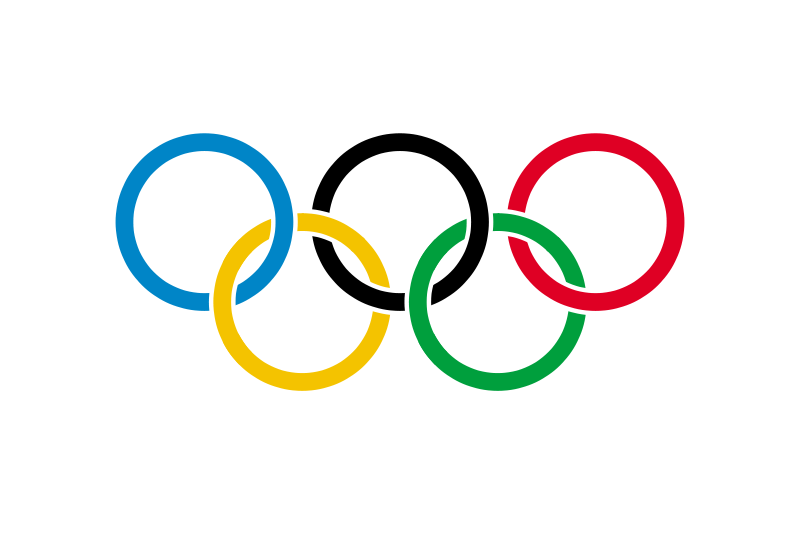
The Olympic Rings became the symbol of the Olympic Games in 1913. The five rings represent the fact that countries from all five continents of the world take part in the games. Each ring is a different color, and at least one of the five colors (Blue, Yellow, Black, Green, and Red) can be found on the flag of every country in the world. The rings do not represent particular continents.

Olympic Games


The Olympic Games is a sporting event that takes place in a different city every four years. It includes many of the best athletes from all over the world. The first modern Games were held in Athens in 1896. The Motto of the Olympic Games is "Citius, Altius, Fortius," which means, in English, "Faster, Higher, Stronger."
There are separate games for the summer and winter. The Summer Olympic Games has many sports, including athletics (track and field events such as sprint, marathon, and discus), swimming, gymnastics, cycling, boxing, soccer, weightlifting, wrestling, basketball, and many other sports. The Winter Olympic Games also have many sports, but they are played in the winter. These include curling, skiing, speed skating, luge, bobsled, figure skating, and ice hockey.
Athletes win medals made of gold, silver, and bronze for coming in first, second, and third place in the Olympics.
The most recent Summer Olympics were held in 2008 in Beijing, China; before that, they were held in Athens, Greece in the year 2004. The next ones will be held in London, Great Britain, in 2012.
The most recent Winter Olympics were held in 2006 in Torino, Italy; before that, they were held in Salt Lake City, United States, in 2002. The next ones will be held in Vancouver, Canada in 2010.

International Olympic Committee

International Olympic Committee
The International Olympic Committee is an organization based in Lausanne, Switzerland, created by Pierre de Coubertin and Demetrios Vikelas on June 23 1894 to reinstate the Ancient Olympic Games held in Greece between 776 BC to 396 AD. Its membership is 203 National Olympic Committees.
Presidents
Demetrius Vikelas (1894–1896)
Pierre de Coubertin (1896–1925)
Henri de Baillet-Latour (1925–1942)
Sigfrid Edström (1942–1952)
Avery Brundage (1952–1972)
Lord Killanin (1972–1980)
Juan Antonio Samaranch (1980–2001)
Jacques Rogge (2001–current)